
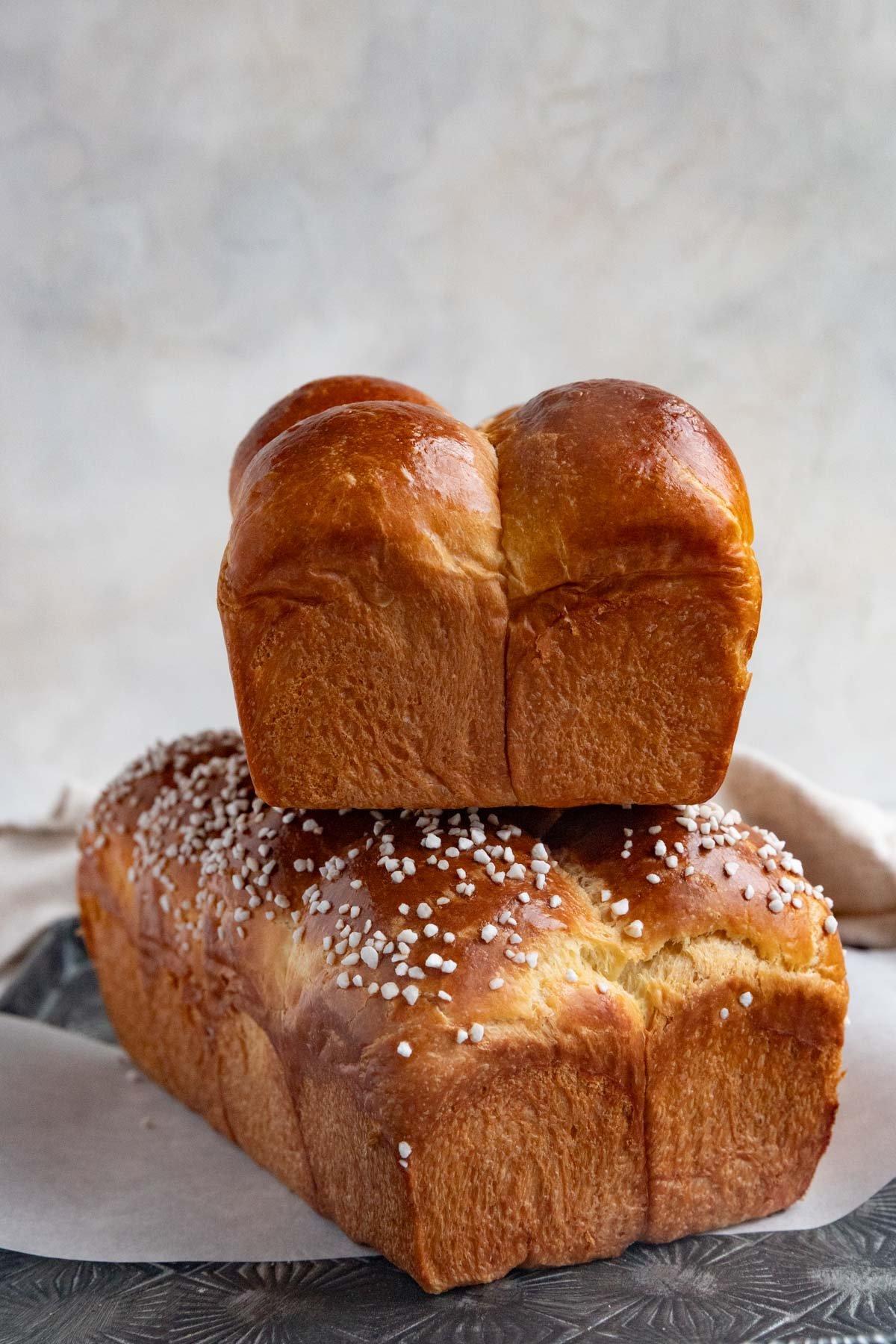
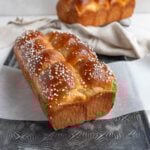
This delicious brioche loaf has a golden brown crust, a tender buttery crumb, and a rich flavor that comes from plenty of eggs, real butter, and an overnight rest. If you haven’t made brioche bread before, I recommend starting with my How to Make Brioche Dough guide where I walk through the mixing, kneading, and windowpane test in more detail. This post is all about shaping and baking the dough into a beautiful loaf.
Why I Keep Coming Back to This Recipe
The rich, buttery taste and soft pillowy texture of brioche bread is what first pulled me in, but it’s the science that keeps me intrigued. How can so many eggs and so much butter go into one dough, and still bake into something so light? I added this recipe to the blog because I want to share that joy with you. Watching these loaves proof and then rise again in the oven never gets old. Every time it works, it feels like a win.
What Makes This Brioche Loaf Stand Out
This recipe is a classic brioche recipe, but I use one extra step that I learned from an old black-and-white episode of Julia Child’s cooking show. After mixing the initial dough, I let it rest for 15 minutes before adding the butter. It gives the dough a chance to relax, which makes it easier to incorporate the butter. That one tweak makes a big difference, especially when you’re working with a stand mixer.
Here are a few details in the method that will help you get great results at home:
- Two-Flour Blend: The mix of bread flour and all-purpose flour gives the loaf a perfect balance, bread flour adds chew and strength, while all-purpose keeps the crumb soft and tender. If you only have unbleached all-purpose on hand, that works too. The final bake will be softer.
- 15-Minute Rest Before Butter: Giving the dough a short rest before mixing in the butter allows the gluten to relax, making it easier to incorporate all that fat without breaking the dough. It’s a small step with big payoff.
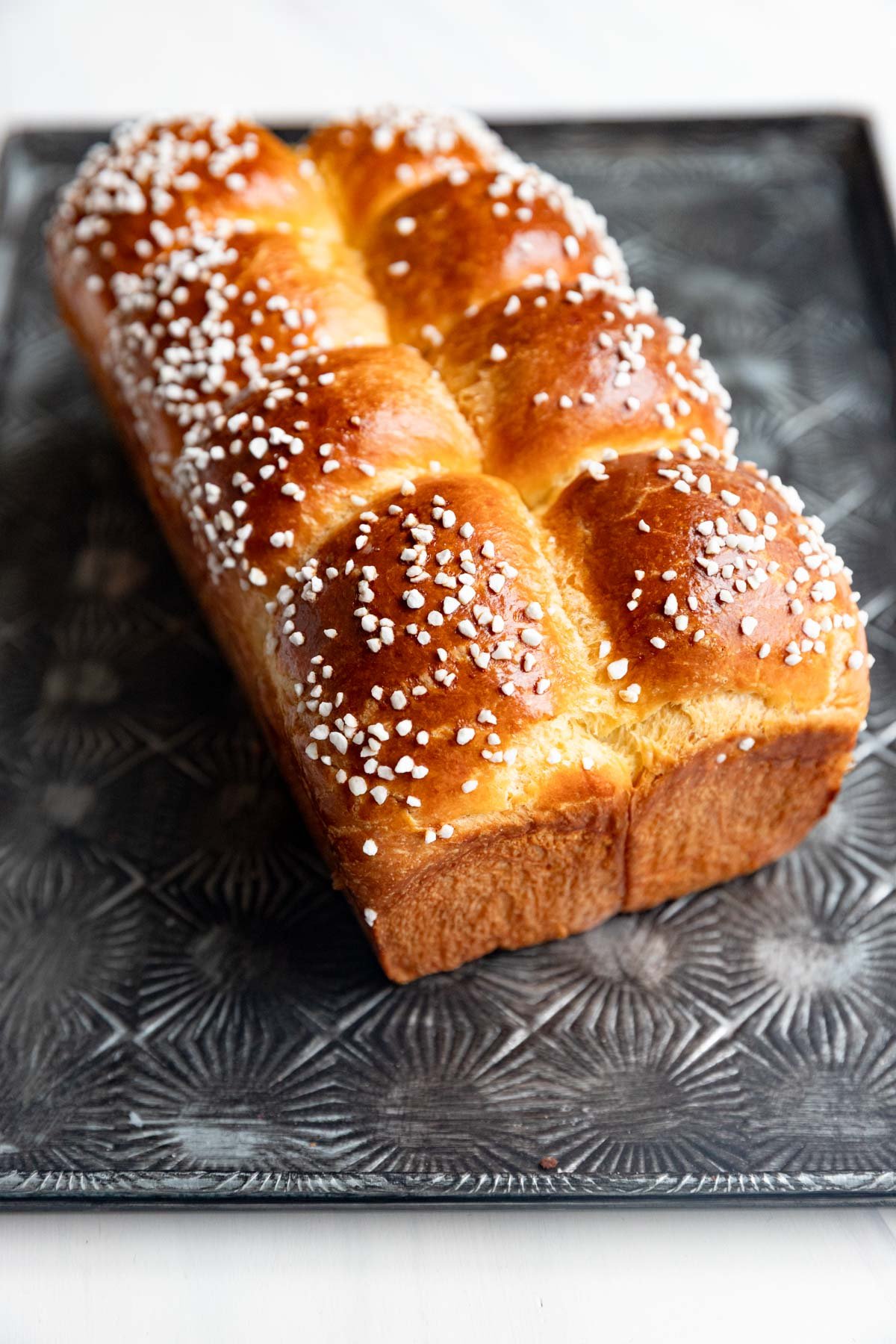
- Classic Nanterre Style Shaping: Instead of a free-form loaf, the dough is divided into eight balls and placed in the pan. This creates a beautiful domed top and gives the option to slice or pull the bread apart.
Tips for Brioche Success at Home
- Don’t rush the chill: After the first rise, refrigerate the dough for at least 2 hours (or overnight). This step isn’t just about timing, it’s key to easy shaping and better flavor. The dough is much softer right after rising and harder to handle. The chill firms it up and makes the shaping process smoother and less frustrating.
- Use a kitchen scale: Divide your dough evenly so the loaf bakes consistently. Each dough ball should weigh about 55 grams. Uniform shaping helps the loaf rise evenly in the oven.
- Have a dough scraper ready: Brioche dough is soft and slightly sticky. A dough scraper makes it easier to handle, especially when transferring or cleaning around the mixer bowl.
- Be patient with mixing: It takes time to develop the gluten and incorporate the butter fully, sometimes up to 30-35 minutes of total mixing. If the dough seems sticky or lumpy during butter incorporation, keep going. It will come together.
- Use gentle shaping: Don’t overwork the dough when forming the balls. A smooth top and sealed seam are key, but there’s no need to deflate the dough completely. That bit of tension is what gives the loaf its height.
- Proof by feel, not just time: The second rise can take 1 to 2 hours depending on your kitchen. The dough is ready when it looks puffed and springs back slowly when gently pressed. If it deflates easily, it’s over-proofed; if it springs back immediately, it needs more time.
- Check the internal temperature: For best texture, bake until the center reaches 190°F. This ensures the loaf is fully baked through without drying out.
Brioche Loaf Ingredients
If you don't have bread flour, you can make this brioche with all-purpose flour.
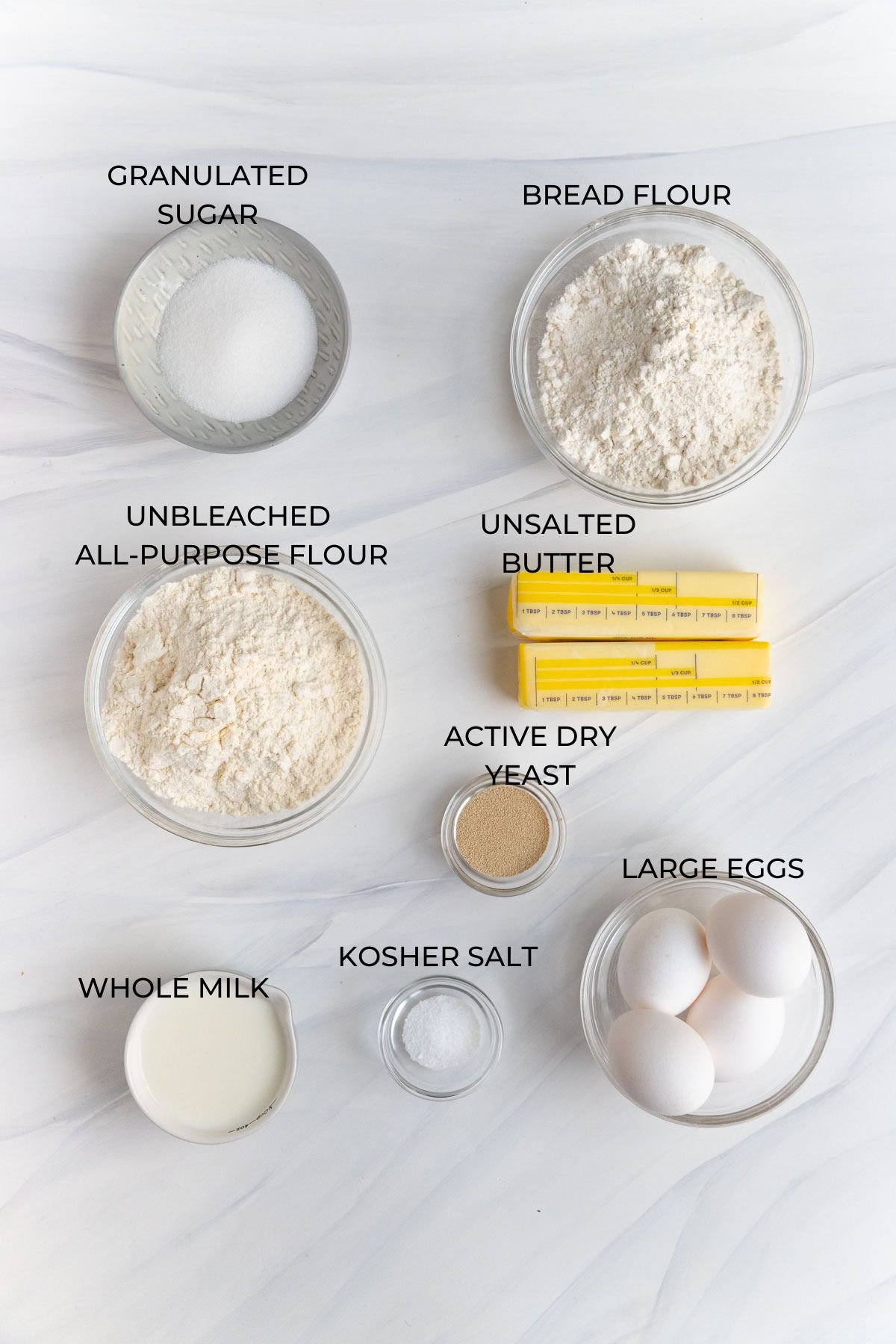
- Eggs: Add richness, flavor, and structure. Since the recipe ingredients are based on the weight of ingredients, weigh your eggs to ensure you're adding enough. Don't go by just the number of eggs, especially if you're using something other than conventionally raised grade A large eggs.
- Unsalted Butter: The key ingredient that makes brioche so rich tasting. It adds richness and softens the texture. I tested this bread with both American-style sweet cream butter and European cultured butter. Both types work for this recipe, but the dough was softer and a little harder to handle with the European butter. I started testing this recipe with American-style butter, so the amount of flour is based on the fat content in that butter, which makes it easier to handle when all the mixing is done. My preferred butter is Tillamook butter., which is 81 percent butter fat. Just 1 percent below the Kerrygold I tested it with, but that 1 percent made a big difference in handling the dough.
Full ingredients, measurements, and instructions are in the recipe card at the bottom of this post.
How to Make Brioche Bread from Scratch
Step 1: Make the brioche dough and follow the steps in making brioche dough.

Step 2: Divide the dough into the 8 even pieces.

Step 3: Place the dough balls in a prepared loaf pan

Step 4: The balls of dough should be lightly touching.

Step 5: Cover the dough and let it rise.
2. Mix the Dough
The preferment is combined with the remaining flour, eggs, milk, sugar, and salt. Knead in a stand mixer on low speed until the dough passes the window pane test.

Step 5: Bake the bread until it is risen and dark golden brown.

Step 6: Cool the bread before before slicing and pulling it apart and enjoying this wonderful bread.
What to Serve with the Brioche
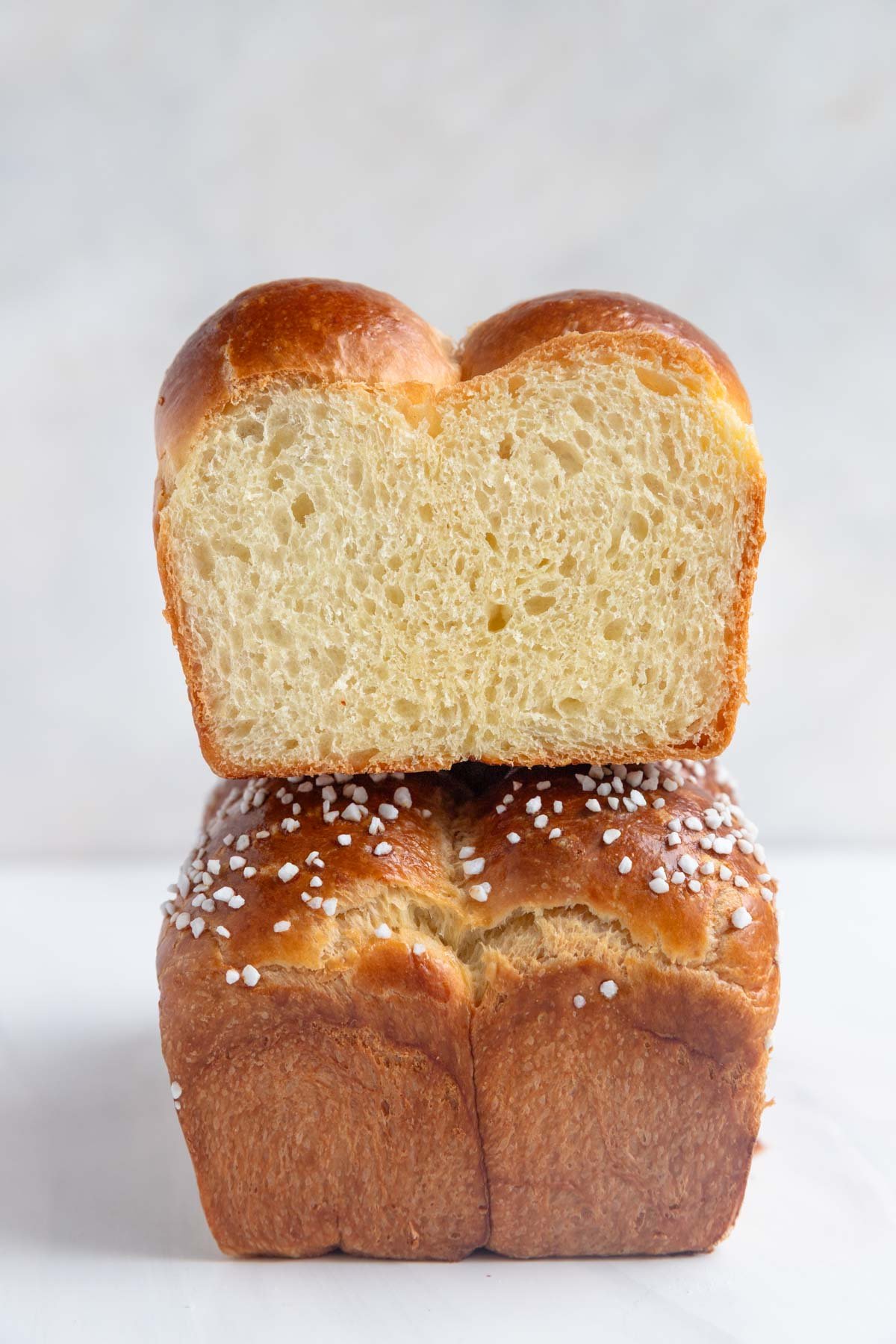
The brioche is buttery and tastes great all by itself especially when it's still warm from the oven. But it does tastes great with homemade strawberry jam or honey butter.
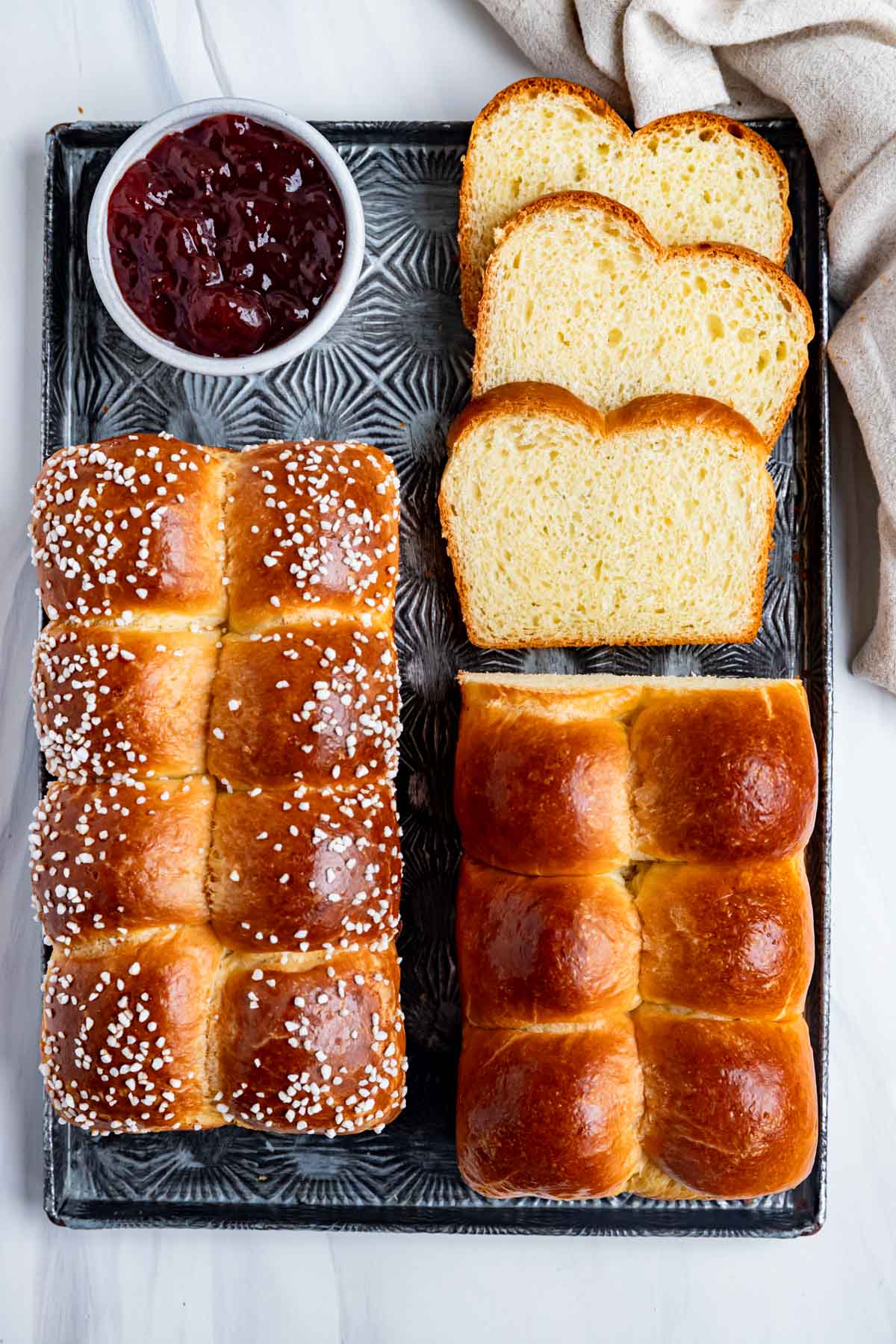
If you make this homemade brioche, please leave a rating and a comment below. I would love to hear from you.
Connect with me on Instagram and tag me @bakesbybrownsugar to share your recipe remake photos.
Like what you see? Click here to subscribe to Bake's by Brown Sugar Baking Newsletter to get free and delicious treats delivered to your inbox.
Want to Save This Recipe?
Enter your email below and I'll send it to your inbox. Plus get new and recommended recipes sent to you every week!
By submitting this form, you consent to receive emails from Bakes by Brown Sugar.

Homemade Buttery Brioche Bread Loaf
Ingredients
Preferment
- 1/2 cup (60 grams) unbleached all-purpose flour
- 1/3 cup (80 ml) whole milk heated to 80-100°F
- 2-1/4 teaspoons (10 grams) active dry yeast
Dough
- 1-1/2 cups (188 grams) bread flour
- 1-1/4 cups (158 grams) unbleached all-purpose flour
- 3 tablespoons (38 grams) granulated sugar
- 4 large (200 grams) eggs cold
- 1-1/4 teaspoons kosher salt
- 14 tablespoons (200 grams) unsalted butter room temperature at 65-68°F
Egg Wash and Topping
- 1 large egg
- 1 tablespoon whole milk
- 2 teaspoons Swedish pearl sugar optional
Instructions
Make the Preferment
- Warm the milk to 80-100°F. In a medium sized bowl whisk together the yeast and the milk. Add the all-purpose flour and mix with a spoon until the mixture is smooth. Cover it with plastic wrap and let it ferment for 45 minutes. If the yeast is good, the preferment will easily triple in volume and the top will be covered with air bubbles.
Make the Dough
- Place the butter in a bowl and beat it until smooth and creamy, using either a hand mixer or a spatula. Refrigerate until it has cooled to 65-68°F.
- Place the bread flour and all-purpose flour in the bowl of a stand mixer and whisk to combine. Add the sugar, kosher salt, the eggs and the preferment to the flour. With the paddle attachment, mix the ingredients together on medium speed for 1 minute until the ingredients come together. If the dough is lumpy, add 1 tablespoon of milk at a time and mix until each tablespoon of milk is incorporated and the dough is no longer lumpy. Usually 1 additional tablespoon is enough. You don't want to start with lumpy dough because it will stay lumpy through out the process.
- Change to the dough hook and mix on low speed (2 on a KitchenAid mixer) for about 16-18 minutes until the dough is elastic and has pulled away from the sides of the bowl. Every 5 minutes scrape the sides and bottom of the bowl.
- To determine if the dough is ready take a small piece about the size of a golf ball, and gently stretch the dough until it is thin and light passes through the dough. If it tears it is not ready. If it doesn't pass the window pane test, mix the dough for another 3-5 minutes.
- Note: Because there is so much butter in this recipe it is important that the dough is elastic, so it can absorb the butter.
- Once the dough has passed the window pane test, remove the dough from the mixing bowl and place it in a small bowl covered with a towel and let it rest for 15 minutes. This rest will relax the dough and make it easier to absorb the butter.
- While the dough is resting, wash the dough hook and mixing bowl so there are no dry hard pieces of dough that get mixed in with the dough.
Add the Butter
- Place the dough back into the mixing bowl. Add the 1/3 of the butter in the middle of the dough. Mix on low speed until the butter is incorporated.
- The butter may smear at first; and possibly work its way from the middle of the dough to the sides of the bowl, so every few minutes, stop the mixer and use a dough scraper to scrape the sides of the bowl and push the dough and butter together towards the center. Continue to add the butter 1/3 at a time and mix until each batch is incorporated.
- After about 16-18 minutes, the dough will start to pull away from the sides of the bowl.
- Once the dough has completely pulled away from the sides of the bowl it is ready. The dough should be shiny, soft, pliable, and cool to the touch and only slightly sticky. The dough should not stick to your fingers. Total mixing time: 22 minutes.
First Dough Rise
- Place the dough in a lightly greased 8-cup measuring cup or a large bowl. Lightly press the dough down, it should come up to the 4-cup mark on the measuring cup. Let the dough rise in a warm spot, until doubled. It should reach the 8-cup mark.
- Punch the dough down by pressing your fist gently into the center to deflate it. Turn the dough out onto a lightly floured work surface. Using the heel of your hand, gently knead the dough for 1-2 minutes, folding it over itself several times, until it forms a smooth, cohesive ball. This brief kneading redistributes the yeast and creates an even texture throughout the dough.
- Place it in the refrigerator in large bowl and let it chill for at least 6 hours and up to 24 hours. Refrigerating the dough slows down the fermentation process, leading to a more complex flavor and better texture for the bread.
- Note: If you're in a hurry, you can shape the dough after just 2 hours of chilling. It will be easier to handle at this point. While it won't have as much developed flavor as an overnight chill, it will still taste delicious.
Shape the Loaves
- Divide the dough into two equal pieces. Place one piece back in the refrigerator until ready to shape it.
- Working with one piece of dough at a time, divide it into 8 equal portions, weighing about 55 grams each using a kitchen scale.
How to Shape Dough Balls (Detailed Instructions for Beginners):
- Take one piece of dough and place it on a clean, unfloured work surface. The slight stickiness of the dough against the counter will help create tension as you shape.
- Using the palm of your hand, gently flatten the dough piece into a small disc, about 3 inches across. Don't press too hard, you want to flatten it while keeping some of the air bubbles intact.
- Form your dominant hand into a "cage" shape: curve your fingers and thumb to create a dome over the dough, with your fingertips and the base of your palm touching the work surface around the edges of the dough.
- Create a "V" shape with your thumb and index finger, positioning this V at one edge of the flattened dough.
- Begin rolling the dough in a circular motion using your cupped hand. The key is to maintain gentle downward pressure while moving your hand in small circles. Your palm should stay curved over the dough like a dome.
- As you roll, the dough will begin to gather and tighten underneath your hand. The friction between the dough and the counter (created by your gentle pressure) will help create surface tension.
- Continue this circular rolling motion for 30-60 seconds, gradually reducing the size of your circles as the dough forms into a tight ball. You should feel the dough becoming more taut and round.
- The finished ball should be smooth and tight on top, with all the seams gathered and sealed on the bottom where it touches the counter.
- Repeat with remaining 7 pieces.
Assemble and Final Rise
- Lightly grease a 8.5 x 4.5-inch loaf pan. Place the eight dough balls seam-side down in the prepared loaf pan, arranging them in two rows of four balls each.
- Cover the pan with a clean kitchen towel and let rise in a warm spot until the dough is soft to the touch and when lightly pressed with the knuckle of your index finger, it bounces back. This will take about 1-2 hours depending on the temperature of your kitchen.
Bake the Brioche
- Preheat the oven to 350°F. Beat the egg and milk together for the egg wash.
- Once the oven is finished preheating, lightly brush the dough with egg wash using a pastry brush. Be gentle and careful not to deflate the dough. Optionally you can also sprinkle the top with pearl sugar, which adds a nice crunch.
- Bake until the brioche has risen, turned a dark golden brown, and the internal temperature in the center reaches 190°F, about 30-35 minutes.
- Remove from the oven and let sit in the pan for 10 minutes. Run an offset spatula around the edges and invert the loaf onto a wire rack to finish cooling.
Serving
- Allow the brioche to cool for 30-45 minutes before slicing for the best texture while still enjoying it warm. For pull-apart style, you can gently separate the rolls after 20-30 minutes.
Storing the Dough
- Store covered or wrapped in plastic at room temperature for up to 3 days. To freeze the bread, wrap it in plastic wrap or aluminum foil, the place it in a freezer storage bag. The bag can be frozen for up to 3 months.
Notes
Nutrition









Jeanne says
Very tender and a success! Thank you 🙂
Cheryl Norris says
Hi Jeanne
Thank you making this brioche and the review. I appreciate you letting me know that the recipe works for you!😁
Susan Mantz says
Thank you! The bread looks wonderful and I love your baking tips which are very helpful.
Cheryl Norris says
Hi Susan
I'm so glad you like this recipe and found the baking tips helpful.😁