
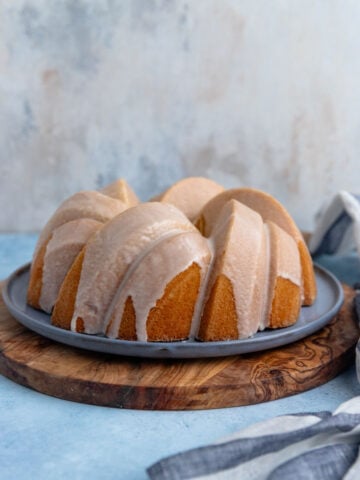
This buttery orange bundt cake is rich with fresh citrus flavor from the fresh orange zest and juice. The buttermilk gives it a soft, open crumb and the citrus glaze brings just the right amount of zing. The cake bakes up golden brown with a slight crust that soaks up a warm orange syrup, making each slice extra moist and flavorful.

A Recipe from My Mom’s Notebook
This recipe came from one of my mom’s handwritten notebooks. When I found the notecard, tucked between two other recipes, I knew I had to try it. So I tested this recipe multiple times to get the details necessary to ensure your success.
I’ve been adding more bundt and pound cakes to the blog, and this felt like the right time to share one that connects me back to her. I love having pieces of her legacy in my baking. There’s something special about seeing her recipes live on in my kitchen and now here on the blog.
Like the recipe for my Blood Orange Pound Cake this cake packs plenty of sweet tart citrusy flavor. And if you like citrus cake in general, try my Southern Lemon Pound Cake (a recipe from my Texas aunt) and my Meyer Lemon Pound Cake, a tasty combination of lemon and cardamom.
Small Tweaks That Make a Big Difference
There are a lot of orange bundt cake recipes out there, but here’s what makes this one special:
- No baking soda. The original recipe does not use baking soda. Most orange bundt cakes call for baking soda, but after testing this recipe I left it out on purpose to preserve the tang of the orange juice. Baking soda would neutralize that acidity and mute the citrus flavor.
- Buttermilk, not sour cream. I tested this recipe with sour cream and buttermilk and discovered that buttermilk helps the cake rise higher and creates a light, tender crumb. The cake is taller with the buttermilk because of the way the lactic acid in the buttermilk reacts with the baking powder. Though I love sour cream in my desserts it made the cake too dense during testing.
- Slow sugar addition during creaming. I learned from another baker that adding sugar 1/2 cup at a time increases aeration and helps dissolve the sugar, which contributes to a tender texture and better moisture retention.
- Two citrus finishes instead of one. Most recipes use just a glaze. My glaze includes a warm orange soaking syrup brushed over the cake while it's still warm, then a citrus glaze after the cake cools. The syrup keeps the cake extra moist and adds another layer of fresh flavor.
Orange Bundt Cake Ingredients
Here are the ingredients you'll need for this incredible and citrusy orange bundt cake recipe:

- Fresh Oranges: The fresh orange zest and orange juice are the main flavors of the cake. Zest the oranges directly into the sugar and rub it into the sugar to maximize the flavor of the orange zest. Look for oranges that have a shine to the orange peel. The shine indicates that there is still plenty of oil in the peel. If the peel looks shriveled or dull don't use the oranges for zest.
- Pure Almond Extract: The almond pairs well with the all-natural orange flavor in the cake which is why I added it to the cake. You can make the cake without it, but it does add a nice subtle flavor to the cake.
- Citrus Glaze: This glaze is a delicious combination of powdered sugar, kosher salt, orange juice, which provides sweetness and lemon juice which provides the right amount of tartness to complement the sweetness of the other ingredients and the cake.
Full ingredients, measurements, and instructions are in the recipe card at the bottom of this post.
How to Make Orange Bundt Cake
Baking Tip: One of the key steps for success in this recipe is to gradually add the sugar to the butter. Adding the sugar to the butter a little at a time while creaming them together helps incorporate air into the mixture. This air gets trapped in tiny pockets throughout the batter, which expands during baking and gives the cake its light and fluffy texture.
Step 1: Prep the bundt pan. Melt the butter and then stir it together with the flour. Use a pastry brush to cover the inside of the pan evenly. Be careful to get into every crevice.
Step 2: Place the flour, baking powder, and salt in a medium-sized bowl and whisk the ingredients until well combined.

Step 3: Zest the oranges directly into the sugar to capture the oils and moisture in the skin of the oranges.

Step 4: With your fingers rub the orange zest into the sugar until the sugar starts to clumps (from the moisture in the orange zest) and turns orange.

Step 5: Cream the butter in the bowl of a stand mixer using the paddle attachment. Then gradually beat in the sugar.

Step 6: Add the eggs one at a time, beating on medium until each egg is incorporated. Add the orange juice and mix on medium speed until incorporated.

Step 7: Add 1/3 of the dry ingredients and mix on low speed just until the flour is incorporated.

Step 8: Add half the milk and mix until just incorporated. Repeat these steps, alternating the addition of the flour and milk.

Step 9: Scrape the sides and bottom of the mixing bowl. Mix the cake batter on low for another 20 seconds.

Step 10: Spoon the batter into the bundt pan, evenly distributing the batter around the pan.

Step 11: Bake the cake until it has risen, is golden brown.
Step 12: Remove the pan from the oven and place it on a wire rack to cool for 15 minutes.
Baking Tip: Don’t let the cake cool longer than 15 minutes. If the cake is left in the pan too long it will restick to the pan and break apart when you invert it from the pan.

Step 13: Invert the cake onto a large wire rack covered with parchment paper. Immediately brush the cake with the orange soaking syrup.

How to Make the Orange Glaze
Combine the powdered sugar, the orange juice, the lemon juice, and the kosher. Stir until the glaze is smooth. At this point, the glaze will be very thick. Add the remaining orange juice 1/2 teaspoon at a time until the desired consistency is reached.
Spoon the glaze over the cake once it has completely cooled.

Pro Tips for Making This Recipe
- Use a kitchen scale to weigh the flour, butter, and eggs. Weighing the eggs is especially important if you’re using organic cage-free eggs. I typically use conventional large-grade AA eggs, which have a consistent weight of 50 grams.
- Cream the butter and sugar and don’t skip this step. I add the sugar 1/2 cup at a time while creaming with the butter. This helps aerate the batter and dissolve the sugar more evenly and produces a soft, fluffy crumb.
- Add the eggs one at a time to ensure they emulsify with the butter and sugar. A large portion of the egg is water and since the sugar and butter mixture, you’re trying to emulsify fat and water. Adding too many eggs at one time will make it harder for this emulsification to take place.
- Follow the cooling time for the bundt cake. Once the cake comes out of the oven it needs time to finish setting and to start to release from the pan. If you invert it too soon the cake will stick. If you wait too long, the cake will start to restick to the pan.

If you make this Orange Bundt Cake please leave a rating and a comment below.
Connect with me on Instagram and tag me @bakesbybrownsugar to share your recipe remake photos.
Like what you see? Click here to subscribe to Bake's by Brown Sugar Baking Newsletter to get free and delicious treats delivered to your inbox.
Want to Save This Recipe?
Enter your email below and I'll send it to your inbox. Plus get new and recommended recipes sent to you every week!
By submitting this form, you consent to receive emails from Bakes by Brown Sugar.

Moist Orange Bundt Cake with Buttermilk
Ingredients
Pan Release
- 1 tablespoon (14 grams) unsalted butter melted
- 1 tablespoon (8 grams) unbleached all-purpose flour
Orange Bundt Cake
- 3-1/2 cups (438 grams) unbleached all purpose flour sifted
- 1 teaspoon kosher salt
- 1-1/2 teaspoons baking powder
- 3 cups (600 grams) granulated sugar
- 2 tablespoons (12 grams) orange zest
- 20 tablespoons (282 grams) unsalted butter room temperature
- 5 large (250 grams) eggs room temperature
- 1 teaspoon almond extract
- 1 teaspoon pure vanilla extract
- 3/4 cup + 2 tablespoons ((210 grams) buttermilk room temperature
- 1/4 cup (60 ml) orange juice
Orange Soaking Syrup
- 3 tablespoons (45 ml) orange juice
- 2 tablespoons (30 ml) lemon juice
- 1/3 cup (67 grams) granulated sugar
- 2 tablespoons (28 grams) unsalted butter
Orange Glaze
- 2 cups (240 grams) powdered sugar sifted
- 1/8 teaspoon kosher salt
- 3 tablespoons (45 ml) orange juice divided
- 1 tablespoon (15 ml) lemon juice
Instructions
- Preheat the oven to 325°F.
Pan Release
- Melt the butter, then stir it with the flour until it forms a paste. Use a pastry brush to cover the entire inside of the pan with the paste. Be careful to get into every crevice. I find it easier to brush from the base up. (If the mixture becomes too thick to brush on, microwave it for about 10 seconds, or until warm and softened.)
For the Cake
- Crack the eggs into a separate bowl. Put the flour, baking powder and salt together in medium-sized bowl and whisk together for 30 seconds.
- Place the sugar in a medium-sized blow and zest the oranges directly into the bowl on top of the sugar. Use your fingers to rub the zest and sugar together. This method better releases the oils and flavor of the orange zest into the cake batter.
- For this cake you will need 3/4 cup in total of orange juice - 1/4 cup for the cake, 1/3 cup for the soaking syrup and about 3 tablespoons for the glaze. After zesting your oranges juice them until you 3/4 cup of juice.
- Whisk 1/4 cup of orange juice into the buttermilk.
- Place the butter in the bowl of a stand mixer and with the paddle attachment mix on medium speed for 1 minute. Scrape down the sides and bottom of the bowl.
- Add 1/2 cup of the orange-sugar mixture and beat on medium speed for 30 seconds, Stop the mixer, add another 1/2 cup of the sugar mixture and beat for 30 seconds. Repeat this step until all the sugar is added. Stop after the 3rd addition and scrape down the sides and bottom of the bowl and the paddle attachment. After all the sugar is added beat the cream and sugar for 2-3 more minutes on medium speed until the mixture is creamy and fluffy.
- Scrape down the sides and bottom of the bowl and the paddle attachment. Add the eggs one at a time and beat on medium speed until each egg is well incorporated, about 20 seconds. Stop the mixer after adding the first 3 eggs and scrape the bowl from the bottom to ensure the ingredients are well mixed. Add the remaining 2 eggs one at time and scrape the down the sides and bottom of the bowl after beating in the last egg. Mix in the almond extract and vanilla extract on medium speed until well combined.
- Add one-third of the dry ingredients and mix on low speed until well combined, but do not over mix. Add one-half of the buttermilk mixture and mix on medium speed until well combined. Add half of the remaining dry ingredients, then the rest of the buttermilk, mixing after each addition. Add the remaining the dry ingredients and mix until just combined. Scrape down the sides and bottom of the bowl and mix on low speed for about 30 seconds to make sure the batter in well mixed.
- Scoop the batter into the prepared bundt pan. Use an offset spatula to spoon the top of the batter. Next place a kitchen towel on the counter and bang the bundt pan 4-5 times to settle the batter in the groves of the pan and break up any air bubbles.
- Bake for 55-65 minutes until a skewer inserted in the center comes out clean or if using an instant-read thermometer and take the temperature in the center of the cake. The temperature should be 203 degrees F.
- Remove the cake from the oven and place on a cake rack. Cool the cake in the pan for 15 minutes and then invert onto a cooling rack. Brush the entire surface with the blood orange soaking syrup using all the glaze. Allow the cake to completely cool, about 90 minutes.
For the Orange Soaking Syrup
- As soon as the cake comes out of the oven combine 3 tablespoons orange juice, 2 tablespoons lemon juice, and 1/3 cup the sugar in a saucepan, bring to a simmer and as soon as the sugar is dissolved remove the pan from the heat and whisk in the butter until butter is melted and thoroughly combined into the glaze.
- Remove the cake from the oven and place on a cake rack. Cool the cake in the pan for 15 minutes and then invert onto a cake rack. Brush the entire surface with the orange soaking syrup, using all of it. Allow the cake to completely cool before adding the orange glaze, about 2 hours.
For the Orange Glaze
- Place the cake and the rack over a plate to catch the excess glaze.
- Place powdered sugar and salt in small bowl and whisk to combine. Add 2 tablespoons of orange juice and 1 tablespoon lemon juice. Stir together until the juice is thoroughly combined. The glaze will be really thick at this point. Next add the remaining orange juice 1 teaspoon at a time until the desired consistency is achieved.
- If you want a really thick glaze, you won’t need more than 1-2 teaspoons of juice. If you want a really thin glaze you’ll may need up to 2 additional tablespoons of liquid.
Storing the Cake
- The cake is good at room temperature for 2 days in a cake container. The best way to store it in the refrigerator is to cut the cake into pieces (about 2-3 servings in size) and wrap each piece in plastic wrap.
- If you want to store the whole uncut cake in the refrigerator then wrap it in two layers of plastic wrap. Unwrapped cake can dry out in the refrigerator.


Barbara K Rigney says
This cake is very delicious.
I would it use for any occasion
Simply delightful
Cheryl Norris says
Hi Barbara
Thank you so much for this review. I'm happy that you enjoyed the cake.
Caity Trial says
Hi can I add chocolate chips to this recipe?
Cheryl Norris says
Hi Caity
I haven't tried that, but it sounds delicious. I say go ahead and give it a try. If I were experimenting with this addition I would probably start with 4 ounces of chocolate. Let me know how it turns out.
Audrey Glantz says
Tried it . . . loved it! The perfect texture. Pound cakes can turn out dense but this recipe produced a soft moist cake without that cloying heaviness.
Next time I plan to double the orange zest to really push that citrus flavor!
Cheryl Norris says
Hi Audrey
Thank you for visiting the blog and trying this recipe. I know you have a lot of choices. I'm so glad you enjoyed this recipe. I got this recipe from my mom's handwritten notebook of recipes. I don't know where she got it from but it's definitely one of my favorite recipes. If you do double the orange zest please let me know what you think. I tried that when testing the recipe and found that a lot orange zest overwhelmed the other flavors in the cake.
Thomas S. says
I just had my first piece of this. The orange stands out, and the inclusion of lemon gives it a zing! Thank you for sharing your recipes!
Cheryl Norris says
Hi Thomas
Thank you so much for trying my recipe and leaving this lovely comment. I'm so glad you enjoyed the cake and the orange flavor.
Carmel says
Hello, Cheryl!
Your cake looks delicious! Anything with oranges is always so refreshing. Will definitely be trying this recipe.
I make a very similar cake (Orange Blossom Cake), but add Grand Marnier.
I make in a tube pan because it's easier to decorate it with sugar honey bees on top.
Jacqueline McDonald says
This recipe is extremely well written, especially for beginners. I love how it is written in grams as well because any his baker uses grams because it's more accurate. The cake itself is most and delicious! Saving this one! Thank you!
L'Tanya Mari' says
Awesome recipe! I followed every single step and baked the cake on Christmas Day. The cake was delicious, it was gone by the end of the weekend.
Thank you for sharing this lovely recipe.
Cheryl Norris says
Hi L'Tanya
Thank you for trying this recipe and writing this wonderful review. I'm so glad you enjoyed it.
Jennifer Galas says
This looks so good. Are you familiar with the Wilton mini-bundt pan with 12 wells? I think they are smaller than on the 6-well pan you have on your site. Do you think this recipe would work with the 12-cavity pan? I'm sure I would have to reduce the amount of batter significantly.
Cheryl Norris says
Hi Jennifer
While I haven't made mini bundts it should work. Check the Wilton pan to see if shows how many cups it will hold. Since the original recipe is made for a 12 cup bundt divide whatever cup information is on the Wilton pan by 12. For example if the mini bundt says 4 cups, divide 4/12 = 0.333, then multiply the recipe ingredients by 0.333. The other option is to simply cut the recipe in half and make cupcakes with any leftover batter. Let me know if you have any more questions.
Jennifer Galas says
Thank you, Cheryl! I won't get to try it for a few weeks, but when I do I will let you know. I'm nervous about the mini bundts coming out of the wells, but your tips from your other blog post should help.
Cheryl Norris says
You're welcome and the overflow is a legit concern. Make sure you fill the wells about 3/4 full.
Jennifer Galas says
I baked this recipe today in the mini bundt pan. It came out perfectly! I made one-quarter of the full recipe, which resulted in about 36 grams of batter per well. That turned out to be just the right amount. I baked them for 17 minutes and let cool for 10 minutes before popping the little cakes out of the wells. The soaking syrup and glaze took them over the top! Thank you!
Cheryl Norris says
Hi Jennifer
Thank for this review and the detailed information on making the mini bundts. That is so helpful for my future recipe testing.
Lori says
This orange bundt cake has amazing texture and is so delicious. Can lemon juice/zest be used in lieu of orange?
Cheryl Norris says
Hi Lori
Thank you for trying this recipe and writing this kind review. I'm so glad you like it. If you'd like to try a lemon version, I suggest trying my Southern Lemon Pound Cake.